Are 1500W Ebikes Legal?
Are 1500W Ebikes Legal?
Quick answer: A 1500W ebike is often outside the cleanest low-speed ebike category in the U.S., especially if it can assist above 20 mph on throttle or 28 mph on pedal assist. It may still be sold online, but that does not automatically mean it is legal to ride like a normal bicycle on streets, bike lanes, or paths.
This guide is written for riders comparing real bikes before they buy: Amazon listings, Walmart listings, fat-tire commuters, speed-unlocked models, Sur Ron-style e-motos, Talaria-style bikes, and electric dirt bikes that blur the line between bicycle and motor vehicle.
Quick Answer Box
- 1500W is usually a legal red flag for standard Class 1, Class 2, and Class 3 ebike rules.
- Peak wattage marketing can hide the actual continuous motor rating.
- Speed, throttle behavior, and class settings matter more than the listing headline.
- For commuting, a 750W-or-less Class 2 or Class 3 setup is usually cleaner.
Key takeaway: If the bike’s speed, throttle, wattage, or paperwork is unclear, treat it as a risk until you verify the actual class and local rules.
What the Law Usually Cares About
A lot of online listings use “1500W” because it sounds powerful. The problem is that many U.S. ebike class systems are built around lower-power, lower-speed bicycles with working pedals. When a bike advertises 1500W peak power, 28+ mph speed, or unlockable throttle settings, it starts looking less like a bicycle and more like a moped, motor-driven cycle, or e-moto depending on the state.
In the U.S., many low-speed ebike rules revolve around the same core ideas: working pedals, limited motor assistance, limited speed, and a clear distinction between bicycles and motor vehicles. But state and local rules decide the practical riding experience. A setup that feels acceptable on one road, path, or city route may be restricted somewhere else.
That is why the safest way to evaluate an electric bike is not by the biggest number on the product page. It is by the full system: motor rating, controller behavior, throttle speed, pedal-assist speed, class label, battery safety claims, braking hardware, and whether the bike looks and behaves like a bicycle or an electric motorcycle.
Why Online Listings Can Mislead Buyers
Marketplace listings are written to sell the bike. They often highlight peak wattage, top speed, long-range claims, fat tires, suspension, and aggressive styling. Those are useful details, but they do not answer the core legality question.
Watch especially for language like “street legal,” “no license required,” “off-road mode,” “unlockable speed,” “private road mode,” “1500W peak,” “2000W dual motor,” or “electric dirt bike.” Those phrases do not automatically make a bike bad. They simply mean you need to check the classification before treating it like a normal commuter ebike.
Is Your Ebike Actually Legal?
Before buying, check these common failure points:
- Assuming peak wattage is the same as legal continuous wattage.
- Buying a 1500W bike because the seller says “street legal” without showing class limits.
- Ignoring throttle speed. A throttle that pushes beyond 20 mph can be a problem in many places.
- Using an unlocked mode on public roads after buying a bike that shipped limited.
- Assuming fat tires, pedals, or lights make a high-power bike legal.
If you are unsure, use the RideStreetLegal ebike legal checker before you buy. It is designed for exactly this problem: riders trying to figure out whether a listing is a normal ebike, a gray-area high-power bike, or basically an e-moto with pedals.
Safest Options for Most Riders
The lowest-risk choice is usually not the fastest bike. It is the bike that matches your real route and can be explained clearly if someone asks what class it is.
- For the lowest-risk commute, look for a clearly labeled Class 2 ebike limited to 20 mph throttle assistance.
- For faster road commuting, compare Class 3 pedal-assist bikes and check local Class 3 access rules.
- If you want the 1500W feeling for off-road riding, treat the bike as a high-risk public-road option and verify rules before riding.
- Use the RideStreetLegal checker before buying any 1500W listing.
For a deeper comparison, start with the Class 2 vs Class 3 ebike guide. If you want safer buying options, compare the best street-legal ebikes, the Amazon ebike buyer guide, and the Walmart ebike buyer guide.
If you are comparing Sur Ron, Talaria, electric dirt bikes, or e-motos, start with the Sur Ron laws hub, the electric dirt bike laws hub, and the Sur Ron vs Talaria comparison.
Recommended Riding Gear
Gear does not make an illegal bike legal, but it does make riding smarter. If you are commuting, riding near traffic, locking up outside, or testing a higher-power setup, budget for safety and security before accessories.
- MIPS ebike commuter helmet — A real commuter helmet is the first upgrade for street riding, especially if you ride near traffic. Check Price on Amazon
- Full-face electric bike helmet — For high-power fat-tire bikes, e-motos, electric dirt bikes, or 30+ mph setups, a full-face helmet makes more sense than a casual bike helmet. Check Price on Amazon
- Heavy-duty ebike lock — A good lock matters because high-value ebikes are easy targets outside apartments, campuses, stores, and transit stops. Check Price on Amazon
- Rechargeable front/rear lights — Even if your bike has built-in lighting, secondary lights help visibility and make night riding less sketchy. Check Price on Amazon
- Vibration-proof phone mount — Useful for maps, speed awareness, delivery apps, and emergency access without stuffing your phone into a pocket. Check Price on Amazon
- GPS tracker / alarm — A hidden tracker or motion alarm is a smart add-on for expensive bikes and high-theft areas. Check Price on Amazon
- Protective ebike gloves — Gloves are cheap compared with a hand injury and useful for cold weather, braking grip, and crashes. Check Price on Amazon
Pros and Cons
Pros
- Strong hill climbing and acceleration.
- Can feel more capable for heavier riders or rougher roads.
- Often comes with fat tires and larger batteries.
Cons
- May exceed normal ebike class expectations.
- Can create bike-lane, path, insurance, and enforcement risk.
- Heavier bikes need stronger brakes and better protective gear.
- Online listings may blur peak and continuous wattage.
Next Steps Before You Buy
- Run the Don’t Buy the Wrong Ebike checklist.
- Compare safer commuter categories in the street-legal ebike guide.
- Use the Amazon ebike guide or Walmart ebike guide only after you understand the class and risk level.
- If the bike looks like a Sur Ron, Talaria, electric dirt bike, or e-moto, read the relevant hub before riding it on public roads.
FAQ
Is a 1500W ebike street legal?
Not automatically. It depends on speed limits, throttle behavior, pedals, class settings, and state/local law.
Is 1500W too much for an ebike?
For many standard low-speed ebike frameworks, 1500W is a red flag unless the bike is limited to legal speed and power behavior.
Can I ride a 1500W ebike in a bike lane?
Do not assume so. If the bike operates outside local ebike class limits, bike-lane access can become risky.
What matters more: watts or speed?
Both matter, but enforcement often focuses on how the bike behaves: speed, throttle, pedals, and whether it looks like a motor vehicle.
Are 1500W peak bikes different from 1500W continuous bikes?
Yes. Peak wattage is a marketing burst number; continuous wattage is more relevant for classification, heat, and real performance.
Should I buy a 1500W ebike for commuting?
Only if you understand the legal tradeoff. A Class 2 or Class 3 commuter is usually safer for public-road use.
Final Recommendation
If your goal is simple public-road commuting, choose the clearest legal category you can: a well-documented Class 2 or Class 3 ebike from a seller with real support, clear speed limits, and credible battery safety information.
If your goal is high-speed performance, treat the bike as a higher-risk machine. Verify where it can be ridden, whether it can be registered if needed, and whether your local laws treat it as an ebike, moped, motor-driven cycle, motorcycle, or off-road vehicle.
Before you spend money, start here: run the RideStreetLegal ebike legal checker, then compare safer buying options through the Amazon ebike guide and Walmart ebike guide.
Educational note: RideStreetLegal provides general buyer education, not legal advice. Laws change by state, city, trail system, road type, and enforcement agency. Always verify current local rules before riding or buying.
Sources to Verify Current Rules
Ebike laws change by state, city, land manager, and enforcement agency. Before buying or riding, verify your local rules with official sources.
- CPSC electric and non-powered bicycle standards summary
- PeopleForBikes state-by-state ebike law guide
- NHTSA vehicle importation and certification FAQs
- UL 2849 ebike electrical system certification overview
Looking at a high-speed ebike or budget e-moto?
Once a bike moves into 35–50 mph, 1000W+, or electric dirt bike territory, the shopping question changes. The bike may be fun and still be a poor fit for bike lanes, sidewalks, parks, campuses, or public-road commuting.
Other EKX models to compare
Affiliate disclosure: RideStreetLegal may earn a commission if you buy through EKX links, at no extra cost to you. Product specs, prices, availability, and legal requirements can change. Always verify the current product page and local rules before buying or riding.
High-power buyer warning
If the listing talks about 1000W, 1500W, 2000W, 3000W, or speed unlocks, slow down before buying.
High-wattage listings can be exciting, but they also make the legal category harder to explain. A bike can be fun and still be a poor match for public roads, bike lanes, campuses, parks, or delivery routes.
Use the bike style as the first red flag
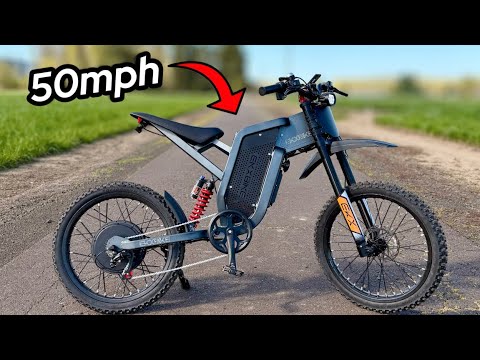
Specs only tell part of the story. The riding position, frame shape, and overall size make it much easier to see why Sur Ron-style bikes sit in a different category from normal commuter ebikes.

The quick filter
How I would sort the listing.
| Listing claim | What it may mean | Best next page |
|---|---|---|
| 1000W+ motor | May fall outside common low-speed ebike limits. | /are-1000w-ebikes-legal |
| Speed unlocked | The bike may no longer behave like the class label suggests. | /are-speed-unlocked-ebikes-legal |
| 35 mph top speed | Higher-risk than a normal Class 3 commuter. | /are-35-mph-ebikes-legal |
| 50 mph top speed | Usually an e-moto/moped/motorcycle-level question. | /are-50-mph-ebikes-legal |
| No pedals or token pedals | Pedals alone do not settle the legal category. | /do-pedals-make-electric-dirt-bike-street-legal |
Affiliate disclosure: RideStreetLegal may earn a commission if you buy through EKX, Amazon, ADO, ENGWE, or other partner links, at no extra cost to you. Product specs, availability, shipping, pricing, local laws, and road-use requirements can change. Always verify the current product page and your local rules before buying or riding. Educational only, not legal advice.
Specs that change the legal question
The numbers explain why these are not normal commuter ebikes.
Legal pages get stronger when they show the actual spec gap. A 60V off-road e-moto, a 45Ah Talaria, a 50 mph EKX X21 Max, and a full-size Stark VARG are not in the same lane as a 20–28 mph commuter ebike.
| Model | Why riders compare it | Battery / power reference | Speed reference | Legal-use takeaway | Next step |
|---|---|---|---|---|---|
| Sur Ron Light Bee X | Lightweight off-road e-moto baseline | 60V battery platform; Luna listing shows 34Ah with 38Ah upgrade options | Commonly discussed around the mid-40 mph off-road lane; verify current model-year specs | Luna states the bike is sold as an off-road vehicle, not for street use. | Official SurronRetail reference |
| Talaria Sting R MX4 | Closest Sur Ron-style rival | 60V 45Ah / 2700Wh battery listed by Luna | Factory limited to 20 mph; Luna notes over 40 mph if the limiter is removed | Luna states it is sold as an off-road vehicle, not for street use. | Retail reference |
| EKX X21 Max | Budget e-moto with pedals | 60V 30Ah battery; 3000W rated / 6000W peak listed by EKX | 50 mph claimed by EKX | Pedals can make it feel more bicycle-adjacent, but this still needs an e-moto legal check. | Check EKX X21 MaxLegal check |
| EKX TX1 | Budget dirt-bike-style EKX | 60V 30Ah battery; 3000W rated / 6000W peak listed by EKX | 45 mph claimed by EKX | More dirt-bike-first than commuter-first; research off-road/private-land use first. | Check EKX TX1 |
| Stark VARG EX / MX | Premium full-size electric motorcycle lane | Full-size electric off-road platform; verify configuration on Stark’s site | Far beyond normal ebike category | Treat as a motorcycle/off-road motorcycle purchase, not an ebike replacement. | Stark VARG EXStark VARG MX |
| Stark VARG SM | Purpose-built road/supermoto lane | Street/supermoto version from Stark | Road-use category depends on market, homologation, and local registration | This is the lane riders should study when they want a purpose-built road-use electric motorcycle rather than an ebike gray area. | Stark VARG SM |
The clean explanation
Pedals can soften the bike’s feel, but they do not erase the spec sheet.
This is the safest EKX angle: the pedal setup can make the bike feel more bike-adjacent than a pure no-pedal electric dirt bike, but once speed and power move into e-moto territory, the buyer still needs to check registration, equipment, insurance, and where the bike is allowed.
Affiliate disclosure: RideStreetLegal may earn a commission if you buy through EKX, Amazon, or other partner links, at no extra cost to you. Sur Ron, Talaria, and Stark links here are included as editorial reference links unless otherwise stated. Specs and road-use status can change by model year, trim, retailer, state, and configuration. Always verify the current product page and your local rules before buying or riding. Educational only, not legal advice.